If you’ve got solar panels on your roof, spring is usually good news. Longer days, higher sun angles, and your system finally starts hitting the kind of output it was built for. But if you’re still exporting your extra power back to the grid instead of storing it, this spring might cost you more than it earns you.
Feed-in tariffs across Victoria have fallen to levels that would have seemed unthinkable a few years ago — as low as 1c per kWh, with some retailers now offering as little as 0.3c. For solar owners without a battery, that means the “bonus” power your system produces on a sunny spring afternoon is, for all practical purposes, being given away.
Here’s why that’s happening, what it actually costs you, and what most Melbourne solar owners are doing about it.

Why Feed-In Tariffs Have Fallen So Far
Feed-in tariffs aren’t set by goodwill — they’re set by supply and demand, and right now the middle of the day is drowning in supply. Australia has one of the highest rates of rooftop solar per household in the world. In states like Victoria, that means hundreds of thousands of systems are exporting into the grid at the same time: the sunniest hours, roughly 10 am to 3 pm.
The grid simply doesn’t need that much power in the middle of the day anymore. Retailers and network operators are dealing with what’s often called the “solar duck curve” — a glut of cheap solar at midday and a sharp spike in demand once the sun goes down and everyone gets home, turns on appliances, and starts cooking dinner. Because supply is so high during the day and there isn’t enough storage to smooth it out, the wholesale value of that midday power has crashed. Sometimes it’s worth close to nothing. Occasionally, it’s worth less than nothing, and retailers have to pay to take it.
The result flows directly into your feed-in tariff. A few years ago, exporting a kWh back to the grid might have earned you 8–12c. Today, on some retailer plans, you’re looking at 1c — or less.
What This Actually Costs a Typical Household
Here’s the part most solar owners don’t realise until they look closely at their bill: the problem isn’t that you’re producing too much power. It’s that you’re producing it at the wrong time.
Say your system generates 6kWh of surplus power on a sunny spring day that you’re not using in real time. Without a battery, that power gets exported, and you’re paid somewhere between 0.3c and 1c per kWh — a few cents total for the whole day’s surplus.
That same 6kWh, stored and used that evening instead of being drawn from the grid, is worth whatever your retailer charges you per kWh at night — typically 25–35c. Store it and use it yourself, and you’re not earning a few cents; you’re avoiding a $1.50–$2.00 cost. Multiply that across a full spring and summer of long, sunny days, and the gap between “exporting for nothing” and “storing and self-consuming” adds up to real money — often the difference between a battery paying for itself and one that doesn’t.
This is exactly why spring and summer matter here. These are the months your system is generating the most surplus, which means they’re also the months you’re giving away the most if you don’t have somewhere to put it.
What a Battery Actually Changes
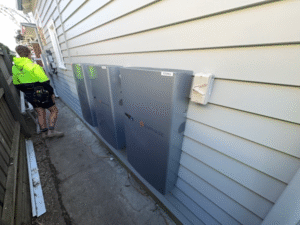
A battery doesn’t change what your solar system produces — it changes what happens to the power once it’s made. Instead of that midday surplus flowing straight out to the grid for next to nothing, it’s stored in the battery and released later, when your household is actually using electricity: cooking, heating or cooling, running the TV, charging devices.
For most homes with existing solar, adding a battery is a retrofit rather than a full system overhaul. It typically involves:
A system check. Your electrician confirms your existing inverter and switchboard can support a battery. Most solar systems installed in the last several years can, with little or no extra work.
Correct sizing. This step determines whether a battery actually pays off. A battery should be sized to your household’s evening usage pattern — not simply matched to the size of your solar system. Oversized or undersized batteries are a common reason people feel underwhelmed by their results.
Installation. For most homes, this is a one-day job with minimal disruption.
VPP enrolment (optional). Many modern batteries can join a Virtual Power Plant, which means your battery can also earn you money by helping stabilise the grid during peak demand periods — an extra income stream on top of the savings from self-consumption.
The Rebates Currently Available — And Why Timing Matters
Government support for batteries has shifted the economics considerably, but these programs are subject to change, and the current settings won’t last forever.
The Federal Cheaper Home Batteries Program currently takes around $3,300 off the cost of a typical 10kWh battery, applied directly to your invoice — there’s no separate rebate claim to lodge. This is the single biggest factor making batteries viable for most households right now. Importantly, the rebate is scheduled to step down from 1 January 2027, so households installing before the end of the year generally lock in the larger discount.
The Victorian Solar Homes Program offers up to $1,400 off if you’re upgrading your solar panels at the same time as adding a battery, for households with incomes under $150,000.
If you got a quote earlier in the year and decided to hold off, it’s worth checking again. Both your eligibility and the rebate amounts can change, and a quote from six or twelve months ago may no longer reflect what you’re actually entitled to.
The Bottom Line
Spring and summer are the two months your solar system will produce the most power it isn’t currently using — which also makes them the two months you’re losing the most by exporting at close to nothing. A correctly sized battery doesn’t just stop that loss; it turns your existing solar system into something that actually covers your evening usage, when electricity is at its most expensive.
With the bigger federal rebate still in place until the end of the year, now is the most cost-effective point to make the switch.